
Optimum machining conditions at any time, reducing non-productive time, avoiding 100% controls: there are many reasons to ensure optimum chip control in series production.
Lasered chip-forming geometries can significantly increase your machining efficiency thanks to optimized chip control and enhanced process reliability - while delivering economic value.
Chip control can be an essential factor for a successfull machining process. Over the years, many different approaches to control chips were established on the market. With 3D-lasered chip forming geometries, SIMTEK now offers the latest technological innovation - with remarkable success and advantages for customers.
Download the free whitepaper now and learn about the necessity of chip control and how it can be achieved by using 3D-lasered tools!

Effective chip control can be an essential factor for safe and cost-effective machining. Tangled chips that wrap around the tool or workpiece and can damage them, or chip residues left in the workpiece that can disrupt automated processes and require rework, are just two possible, undesirable problems that can arise from inadequate chip control.
Chip-forming geometries are used to improve chip control. Conventional chip-forming geometries are produced by pressing, sintering, or grinding; however, they can reach their limits due to wider tolerance ranges (pressing, sintering) or manufacturing-related restrictions regarding form depth and multidimensionality (grinding).
This is precisely where SIMTEK’s 3D-lasered chip-forming geometries come into play. Using a laser, highly complex, three-dimensional chip-forming geometries are applied to the tool, which can improve chip control - for example, through targeted chip breaking or the reliable evacuation of chips from the machining zone.

To ensure that a 3D-lasered tool can reach its full potential, SIMTEK’s experts carefully examine the machining process in its entire scope. Material, cutting parameters, operating conditions, and target specifications - the chip-forming geometry is designed with full consideration of all factors that influence the process.
The experienced SIMTEK design engineers then use 3D-CAD to develop a chip-forming geometry precisely tailored to the specific application, which is subsequently applied to the tool using a laser.
By precisely controlling the laser’s direction and penetration depth, structures such as bumps, bulges, or recesses are created with high precision to optimize chip control.

3D-lasered microgeometries result in precision tools that combine the advantages of lasered chip-forming geometries with those of ground tools - a hybrid solution offering high flexibility and added value, especially when chip-forming geometries manufactured using other processes reach their limits.

Tools with 3D-lasered chip-forming geometries have now become an integral part of SIMTEK’s product offering – even in the standard range and alongside proven ground solutions.
Thanks to impressive results, several lasered chip-forming geometries have already been successfully incorporated into the standard range.
Moving forward, SIMTEK - as one of the pioneers in this field - will continue to invest in in-depth expertise and innovative manufacturing technologies to further expand the use of lasered chip-forming geometries in the medium and long term, including the comprehensive SIMTEK standard portfolio.

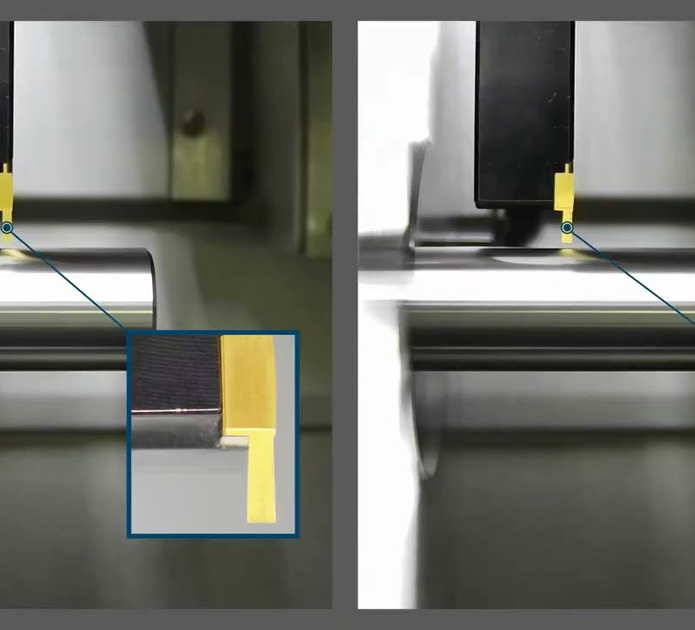
The video shows the benefits of tools with lasered chip forming geometries compared to conventional tools with a ground chip forming geometry.
In the video you see two different applications:
the first application shows grooving and longitudiinal turning while the second application shows grooving and profile turning with full radius.


Double-edged indexable cutting inserts for grooving and longitudinal turning


Triple-edged indexable inserts for grooving and profiling
Norbert Seifermann
CEO, SIMTEK AG

Contact us!
Our team will be happy to help you at any time.


 Solutions

